Top 5 US online gambling regulations for safe PWA betting
Choosing a legal online gambling platform in the United States means navigating a complex web of state regulations, licensing requirements, and compliance standards. With each state setting its own rules for online casinos, sports betting, and poker, understanding the key regulatory criteria becomes essential for safe wagering. This guide breaks down the five most important US online gambling regulations you need to know when selecting a PWA gambling platform, helping you identify licensed operators that protect your funds, ensure fair play, and comply with your state’s laws.
Table of Contents
- Key takeaways
- Key criteria for US online gambling regulations
- Overview of US online casino and sports betting regulations
- Comparing top regulated states for online gambling in the US
- How to choose a legal and secure PWA gambling platform in the US
- Explore top legal US PWA gambling platforms
- FAQ
Key Takeaways
| Point | Details |
|---|---|
| State level regulation | US online gambling is regulated by individual states, so legality varies from state to state. |
| Licensing and compliance | Licensing requires financial stability, strong security, fair gaming standards, and ongoing compliance audits. |
| Age and identity verification | Players must prove they are at least 21 and located in a legal state through government ID and geolocation checks. |
| Responsible gambling measures | Platforms must provide self exclusion, spending limits, and links to support resources. |
Key criteria for US online gambling regulations
Unlike many countries with federal gambling oversight, the United States leaves online gambling regulation to individual states. This creates a patchwork system where what’s legal in New Jersey might be prohibited in Texas. US states individually regulate online gambling through licensing requirements and operational guidelines, making state-level compliance the foundation of legal wagering.
Licensing serves as the cornerstone for legal operation. State gambling commissions issue licenses only to operators meeting strict financial stability, technical security, and fair gaming standards. These licenses aren’t cosmetic, they represent months of background checks, software audits, and proof of player fund segregation. Without a valid license in your state, an operator cannot legally accept your wagers.
Platform compliance extends beyond initial licensing. Operators must maintain ongoing adherence to state regulations covering everything from game fairness testing to advertising restrictions. Regulators conduct regular audits, mystery shopper programs, and technical inspections to ensure continued compliance.
Age and identity verification processes protect both players and operators. Every legal platform requires you to prove you’re at least 21 years old and physically located within a legal gambling state. This involves submitting government ID, answering knowledge-based authentication questions, and allowing geolocation tracking during gameplay.
Mandatory responsible gambling measures form another critical regulatory pillar. Legal platforms must offer self-exclusion programs, deposit and loss limits, reality checks, and direct links to problem gambling support organizations. These aren’t optional features, they’re regulatory requirements designed to prevent gambling harm.
Pro Tip: Always verify a gambling app holds a valid license in your state before depositing funds by checking your state’s gambling commission website or reviewing US state gambling laws for current licensing information.
Overview of US online casino and sports betting regulations
Most states that legalize online gambling create distinct licensing frameworks for casinos versus sports betting. Pennsylvania, for example, charges operators $10 million for a sports betting license but $4 million for an online casino license, reflecting different regulatory complexity and market potential. This separation means some operators hold sports betting licenses but not casino licenses, limiting their game offerings.

Online casino regulations focus heavily on safety and fairness requirements. Game fairness, payout rules, and security standards must meet state specifications, including random number generator certification, minimum return-to-player percentages, and encryption protocols. New Jersey requires all casino games undergo independent testing by approved laboratories before launch, with ongoing monthly audits.
Wagering limits and payout terms fall under strict regulatory control. States set maximum bet sizes for certain games, minimum payout speeds, and required dispute resolution procedures. Michigan mandates casinos pay winnings within 24 hours for amounts under $5,000, while larger sums require additional identity verification but must process within 72 hours.
States allowing or prohibiting specific games create another layer of complexity. Connecticut permits online slots and table games but restricts live dealer poker. Illinois allows sports betting but hasn’t legalized online casino games. Understanding these game-specific restrictions prevents frustration when your favorite game isn’t available.
| Regulatory Aspect | Online Casinos | Sports Betting |
|---|---|---|
| Typical license cost | $4M to $10M | $5M to $12M |
| Game testing requirements | Monthly RNG audits | Odds verification |
| Minimum payout speed | 24 to 72 hours | 24 to 48 hours |
| Tax rate range | 15% to 54% of revenue | 10% to 51% of revenue |
| Self-exclusion required | Yes, all states | Yes, all states |
Pro Tip: Choose platforms licensed specifically for your gambling type and state by reviewing US sports betting regulations and US online casino rules to ensure complete legal protection and game availability.
Comparing top regulated states for online gambling in the US
New Jersey pioneered legal online gambling in 2013 and maintains one of the most comprehensive regulatory frameworks. States like New Jersey, Pennsylvania, and Michigan have comprehensive online gambling licenses covering casino and sports betting, offering players the widest selection of legal platforms and game variety.
Licensing fees and tax rates vary dramatically between states, affecting how many operators enter each market. Pennsylvania charges the highest initial licensing fees but attracts major operators due to population size. Nevada focuses exclusively on sports betting with lower barriers to entry, while West Virginia offers lower tax rates to encourage market participation.
Permitted gambling options differ significantly across legal states. Michigan allows online casino games, poker, and sports betting under one integrated license. New York legalized mobile sports betting in 2022 but still prohibits online casino games. Rhode Island permits both but limits licenses to just two operators, reducing player choice.
Player protection and responsible gaming enforcement varies in strictness. New Jersey leads with mandatory 72-hour cooling off periods for self-excluded players and real-time spending alerts. Connecticut requires operators to contribute 0.25% of revenue to problem gambling programs. Pennsylvania mandates quarterly responsible gaming training for all customer service staff.
States with unique regulatory highlights include:
- New Jersey: Allows international operators, lowest tax rate at 15%, most licensed platforms
- Pennsylvania: Highest licensing fees, permits VGTs in bars, 36% casino tax rate
- Michigan: Integrated licensing for casino and sports, allows tribal operator participation
- Connecticut: Tribal-commercial hybrid model, limited to two online casino licenses
- West Virginia: Lowest barriers to entry, allows existing casino operators automatic online licenses
| State | Casino Legal | Sports Legal | Tax Rate | Active Licenses | Unique Feature |
|---|---|---|---|---|---|
| New Jersey | Yes | Yes | 15% to 17.5% | 30+ | Lowest tax burden |
| Pennsylvania | Yes | Yes | 36% to 54% | 20+ | Highest revenue |
| Michigan | Yes | Yes | 20% to 28% | 25+ | Tribal integration |
| Connecticut | Yes | Yes | 18% to 20% | 2 | Limited licenses |
| West Virginia | Yes | Yes | 15% to 35% | 5 | Easiest entry |
How to choose a legal and secure PWA gambling platform in the US
Selecting a compliant PWA gambling platform requires systematic verification of multiple regulatory criteria. Follow this stepwise approach to ensure you’re wagering legally and safely.
-
Verify platform licensing and state approval by visiting your state gambling commission website and searching their list of licensed operators. Cross-reference the platform’s license number displayed in their footer against official records. Never trust a platform claiming to be “licensed” without verifying the actual license.
-
Check for age verification and identity authentication processes during registration. Legal platforms require government-issued ID upload, knowledge-based questions, and sometimes selfie verification. If a platform lets you deposit without identity verification, it’s operating illegally.
-
Review platform security measures including SSL encryption, secure payment processing, and fund segregation policies. Choosing licensed and compliant PWAs ensures secure transactions and protection under state laws. Look for security certifications from organizations like eCOGRA or iTech Labs displayed on the platform.
-
Look for responsible gambling tools and limits including deposit limits, loss limits, session time limits, and self-exclusion options. Test these features before depositing by setting a small deposit limit to confirm the platform enforces it. Legal platforms must offer these tools prominently, not hide them in obscure menu sections.
-
Read independent reviews for reputation and payout records on trusted gambling information sites. Check complaint forums and Better Business Bureau ratings. Pay special attention to withdrawal speed reports and customer service responsiveness during disputes.
-
Confirm geolocation technology works properly by testing the platform’s ability to detect your location. Legal platforms use sophisticated GPS and IP verification to ensure you’re physically within state borders during gameplay.
-
Review responsible gambling policies and available support resources before committing to a platform. Quality operators provide direct links to the National Council on Problem Gambling, state-specific helplines, and trained support staff.
-
Verify state compliance for gambling platforms by checking whether the operator appears on your state’s approved list and reviewing any regulatory actions or fines in their history.
-
Consider game variety and software providers, ensuring the platform offers games from licensed, regulated developers. For poker players, review legal online poker apps to understand state-specific regulations affecting tournament structures and player pools.
Pro Tip: Use official state regulatory websites and trusted PWA gambling resource platforms to confirm legality rather than relying solely on operator claims or affiliate marketing sites promoting unlicensed platforms.
Explore top legal US PWA gambling platforms
Navigating the complex landscape of US online gambling regulations becomes easier with expert guidance and curated platform recommendations. PWA Wager provides comprehensive resources to help you find legal, secure gambling options tailored to your state’s specific regulations. Access detailed guides on legal gambling by state to understand what’s permitted in your location, from casino games to sports betting and poker.
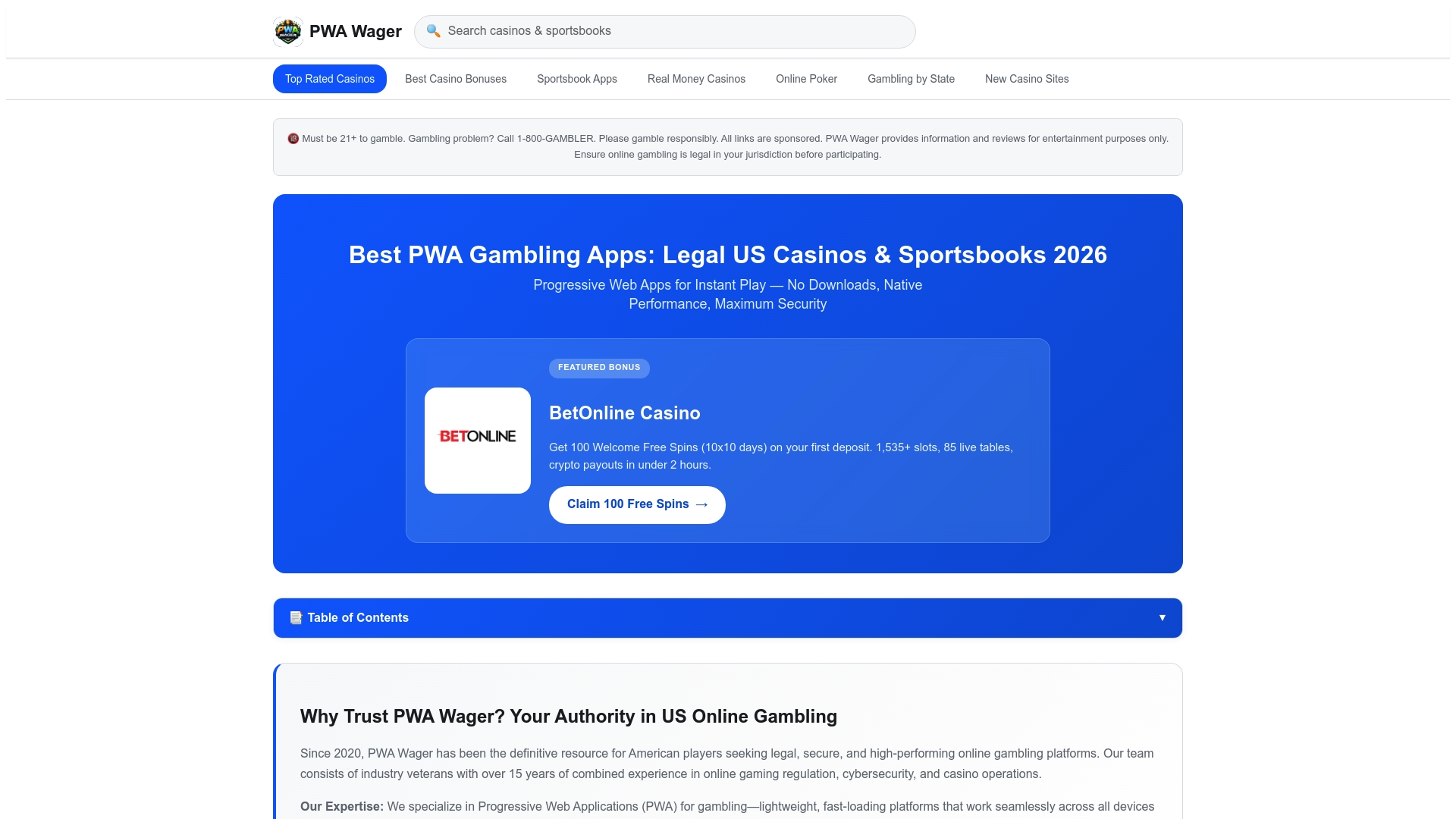
Discover top rated casinos that meet strict licensing and security standards while offering competitive bonuses and fast payouts. Every platform recommendation includes verification of state licensing, security certifications, and responsible gambling features. Access responsible gambling help resources including self-assessment tools, support hotlines, and strategies for maintaining healthy gambling habits within legal, regulated environments.
FAQ
What are the minimum age requirements for online gambling in the US?
The minimum age for online gambling is 21 in nearly all US states with legal online casinos or sports betting. A few states permit 18+ for certain lottery products or tribal casino games, but commercial online gambling platforms universally require 21+. Platforms verify age through government ID checks and database cross-referencing before allowing real money play. Check state online gambling laws for specific age requirements in your jurisdiction.
Why is licensing important for online gambling platforms?
Licensing confirms an operator meets rigorous regulatory standards for financial stability, game fairness, security protocols, and player protection. Licensed platforms must segregate player funds from operating capital, ensuring your money remains safe even if the company faces financial difficulties. State regulators provide dispute resolution services and can force licensed operators to honor legitimate player complaints. Playing on unlicensed platforms offers zero legal protection and no recourse if the operator refuses withdrawals. Verify current online gambling licenses before depositing funds.
Are online poker games regulated differently than other online casino games?
Yes, poker often requires separate licensing and faces unique regulatory considerations due to its player-versus-player nature rather than player-versus-house structure. Some states like Nevada initially legalized only poker before expanding to full casino offerings. Poker regulations typically address tournament structures, rake percentages, player pool sharing between states, and collusion prevention measures distinct from slot or table game oversight. States may permit poker while prohibiting other casino games or vice versa. Review online poker regulation to understand state-specific rules affecting game availability and tournament options.
What responsible gambling measures are required by US online gambling laws?
All legal US online gambling platforms must offer self-exclusion programs allowing players to ban themselves for periods ranging from 72 hours to permanent exclusion. Mandatory deposit limits, loss limits, and session time limits give players tools to control spending. Platforms must display responsible gambling messages, provide reality checks showing time and money spent, and offer direct links to problem gambling support organizations. Many states require operator contributions to problem gambling treatment programs and mandate staff training to identify at-risk players. Access comprehensive responsible gambling policies and support resources to maintain healthy gambling habits.